

L050 Jaw Coupling | L-Type Flexible Coupling
- Model
- L050 Coupling
Item specifics
- Material
- Rubber
- Color
- Natural
- Accuracy
- High precision coupling
- Quality
- Easy Installation and Maintenance
- Interchangeability
- Directly interchangeable with other brands
Review
Description
About L050 L Series Jaw Couplings
CTS® L050 Jaw Coupling
The L050 is the smallest size in our L-series jaw coupling range: a three-piece, torsionally flexible coupling made of two steel hubs and one moulded elastomer spider. It accepts shaft diameters from 6.4 mm to 15.9 mm (1/4" to 5/8"), measures 27.4 mm across the hubs, and is used on small pumps, gear reducers, blowers, agitators, and light conveyors where the two shafts will never be perfectly aligned and some shock load has to be absorbed.
For a quotation or other information on L Jaw Coupling, please contact us, and we will be happy to help you.
Quality Assurance:
ISO9001: 2015 and GB/T24001-2016 / ISO14001: 2015.
L050 L-Jaw Couplings Technical Data
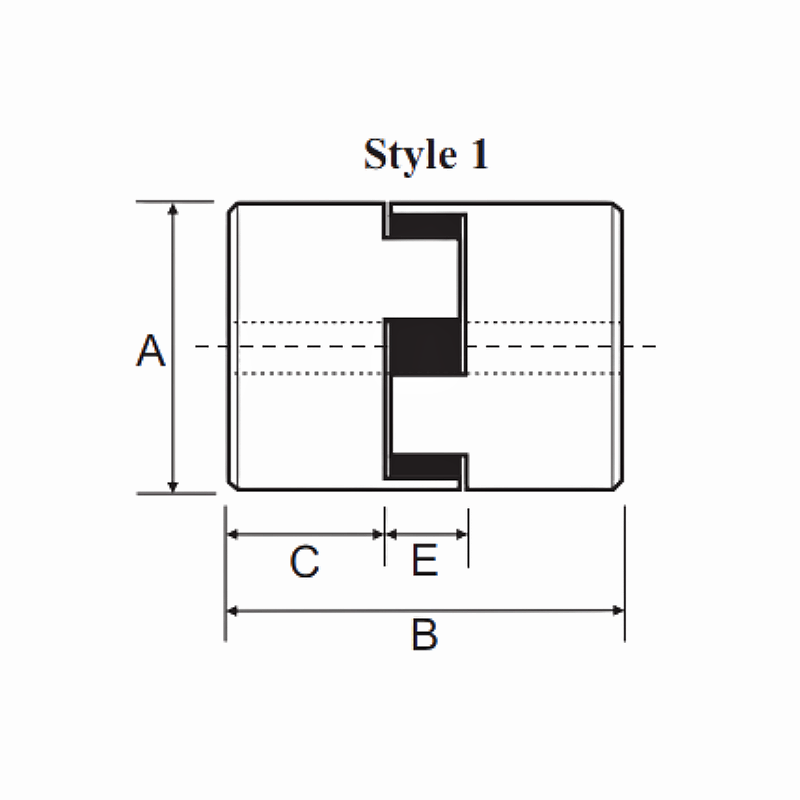
L050 Jaw Coupling Dimensions
- Style No: 1
- Bore Dia(min): 6.4 mm
- Bore Dia(max): 15.9 mm
- A: 27.4 mm
- B: 43.4 mm
- C: 15.7 mm
- E: 12.2 mm
How the L050 Coupling transmits torque
Each hub carries curved jaws that interlock through the spider. Torque passes from one hub, through the spider's teeth, into the second hub — no metal-to-metal contact, no lubrication, and nothing to tighten after installation. The spider also takes up the alignment error between the two shafts and damps the vibration that would otherwise travel into bearings and seals.
✔ Angular misalignment — handled by the spider flexing between the jaws.
✔ Parallel offset — handled by the spider deforming radially.
✔ Axial float — the spider lets the shafts move slightly towards each other under thermal growth.
✔ Electrical isolation — the elastomer element separates the two hubs, so no current path exists through the coupling.
If the spider eventually wears through, the jaws of the two hubs engage directly: the drive keeps turning with backlash, so a worn L050 announces itself as noise and vibration rather than a sudden loss of drive. Replace the spider as soon as that noise appears — running metal-on-metal wears the jaws, and the coupling becomes scrap.
Choose the right spider for Coupling
The hubs are the same for every application; the spider decides how the coupling behaves. Three families cover almost every L050 job:
| Spider | Hardness | Character | Typical Use | ||
| NBR (standard) | ≈ 80 shore A | Best damping, lowest stiffness, most forgiving of misalignment | Pumps, fans, ligh conveyors, general duty | ||
| Polyurethane | 92 / 95 / 98 shore A | Higher torque, better wear resistance, less damping as hardness rise | Positioning drives, frequent starts, small gearmotor | ||
| Hytrel | ≈ 45 shore D | Highest torque capacity of the three closet to a rigid coupling in behaviour | Higher-torque, low-misalignment drives | ||


